

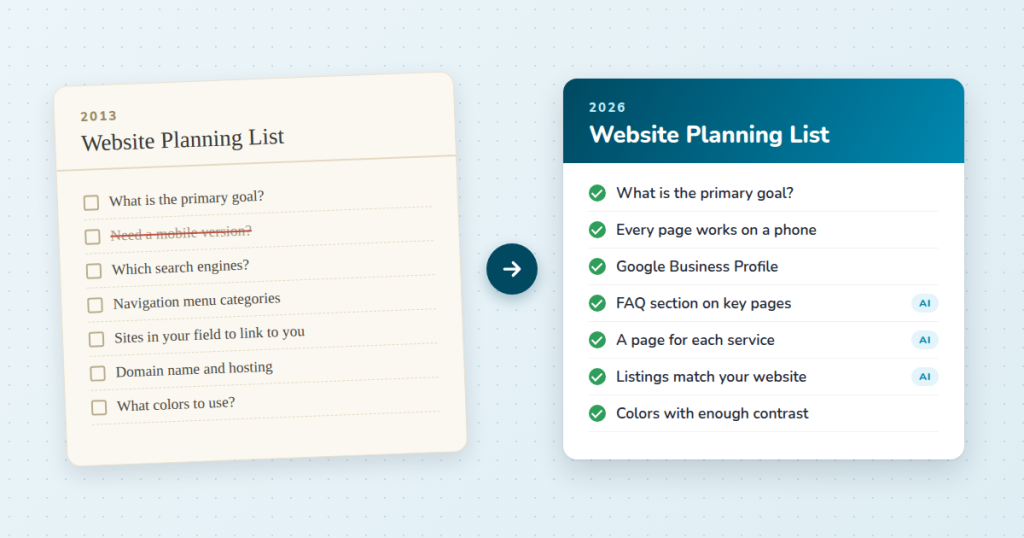
I pulled that list out again this year. Some of the questions still hold up. Others make me smile, like “Will you need a mobile version of your website?” Today for many industries, most visitors arrive on a phone, so the phone version is the website.
The bigger change is who reads your website. In 2013 it was people and search engines. In 2026 it is people, search engines and AI assistants like ChatGPT, Claude and Google’s AI Overviews. When someone asks “who is the best veterinarian near me?”, those assistants build their answer from what they find on the web. A website planned with that in mind has a much better chance of being the answer.
Here is how the list has changed.
What stayed the same
These questions were on the 2013 list and still belong at the top:
- What is the primary goal for your website? What other goals do you have?
- Who are your target customers, and what are they looking for from your website?
- Have you seen any sites you liked? What do you like or dislike about them?
- Do you have a logo, a slogan, brochures or other material about your business?
- How often will the site need to be updated, and what will need updating?
- What is the time frame for completing your website?
A website still starts with knowing what it is for and who it is for. That part has not changed.
What changed
| 2013 | 2026 |
|---|---|
| Will you need a mobile version of your website? | How does every page work on a phone? Most visitors will see that version first. |
| What search engines do you think your customers will be using? | Where will customers look for you: Google, Bing, Google Maps, social media and AI assistants? |
| How do you want people to find your site? | What questions do your customers ask before they buy, and which page answers each one? |
| What categories would you like your navigation menu to include? | Which services and areas need a page of their own? |
| Do you know of any sites in your field that will link to your site? | Where is your business listed, and do those listings match your website? |
| Have you obtained a domain name? Where will you be hosting? | Who owns the domain, the hosting and the logins, and who keeps them up to date? |
| What colors should be used on your site? | What colors fit your brand and still have enough contrast for everyone to read? |
The 2026 Business Website Planning List
Goals and customers
- What is the primary goal for your website? Calls, booked appointments, quote requests, sales?
- What other goals do you have?
- Who are your customers, and what are they trying to get done when they visit?
- What questions do customers ask you most often, before and after they buy?
How people will find you
- Do you have a Google Business Profile? Is it claimed, and does it match your website? (In my November 2026 review of 103 top-ranking veterinarian websites, 94% of the businesses had one.)
- Do you have a Bing Places listing?
- Which social pages do you use, and does your website link to them? (87% of those top vet websites linked to a Facebook page.)
- What would a customer type into Google, or ask an AI assistant, when looking for a business like yours?
- Which towns or areas do you serve?
Pages and content
- Which services need a page of their own? One page per service gives search engines and AI assistants a clear answer to point to.
- Which areas need a page of their own, if you serve more than one town?
- Will each key page have a short FAQ section? Answering the questions customers really ask, in plain words, right on your service pages, is one of the easiest ways to be the answer an AI assistant gives. Start each answer with the answer, then explain.
- Do you have reviews or testimonials you can show?
- What makes your business the right choice? Years in business, licenses, certifications, awards, the people behind it?
- Who will write the content, and who will check that it is accurate?
- Will you have a blog, and who will write for it?
Trust and accuracy
- Is your business name, address and phone number exactly the same on your website, your Google Business Profile and every other listing? AI assistants and search engines compare them.
- Do you have an About page that says who you are and why customers can trust you?
- Will your hours, prices and services be kept current? Out-of-date details are worse than none.
- Do you need a privacy policy? (If your site has a contact form or analytics, the answer is yes.)
Design and accessibility
- Have you seen any sites you liked? What do you like or dislike about them?
- What colors fit your brand, and do they have enough contrast to read easily? The current accessibility standard is WCAG 2.2.
- Do you have photos you own the rights to? Real photos of your business, your team and your work build more trust than stock images.
- Do you have a logo, and do you have it in a digital format?
- Where should your phone number and main button go? (74% of the top vet websites put the phone number in the header.)
Behind the scenes
- Do you own your domain name, and who has the login?
- Where will the site be hosted, and who keeps it backed up and up to date?
- How will you know if the website is working? Do you want to track calls, form submissions and where your visitors come from?
- Does the site need to connect to anything you already use: booking, payments, email or a CRM?
- How often will the site need updating, and who will do it?
- What is the time frame for completing your website?
Free copy of the website checklist
Download a copy of website checklist. Free to use and modify.
Download the Website Checklist